Garage door repair in Scottsdale
Garage Door Spring Repair in Scottsdale, AZ
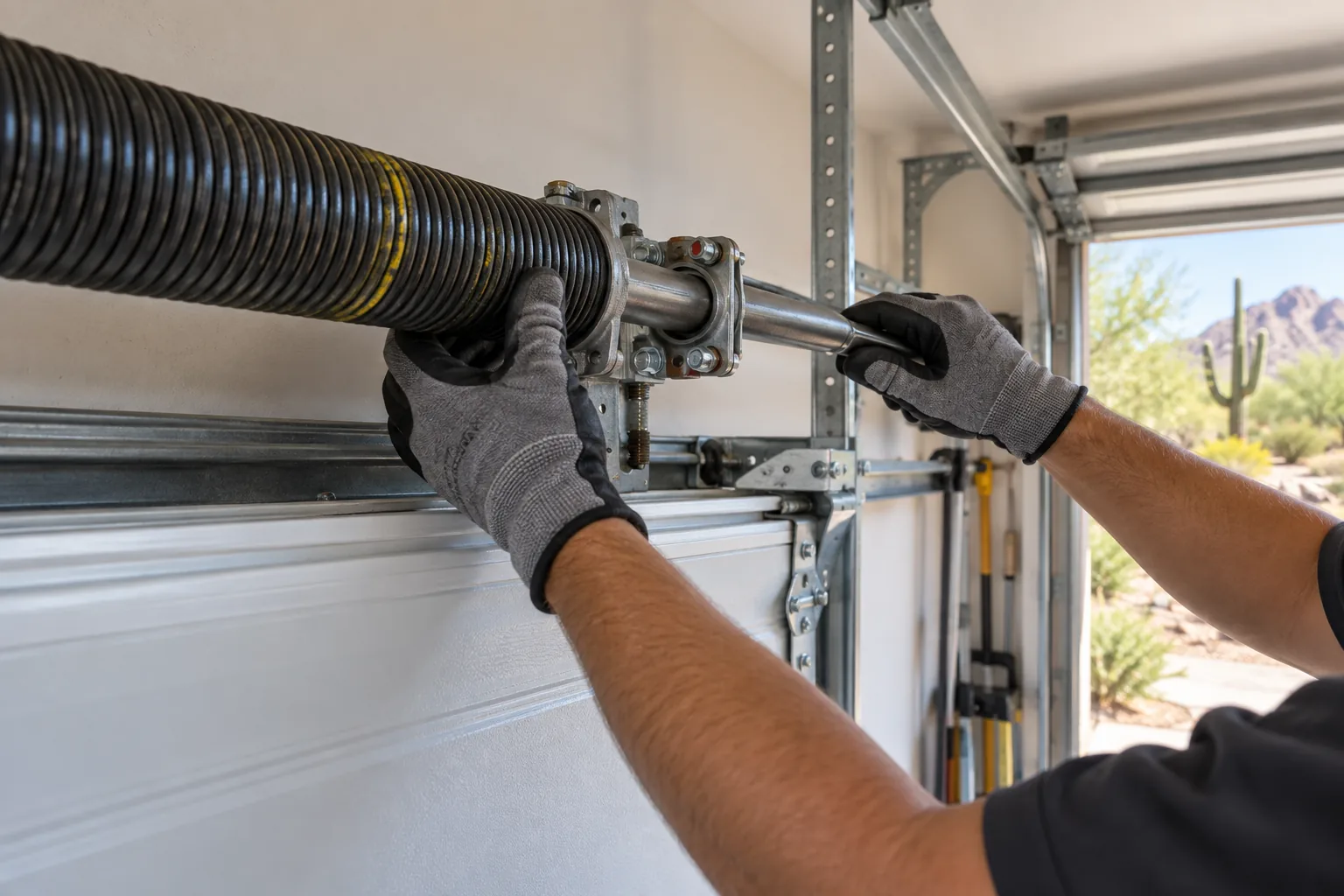
Garage door spring repair in Scottsdale is the visit for a door that went from easy to dangerously heavy. The spring is the counterbalance. It carries the door's weight so a person, or the opener, only has to guide it. When the spring breaks, that weight is real. A double-width insulated door on a north Scottsdale house can be far heavier than it looks, and the opener will try to lift it until the drive or the rail gives up.
The usual warning is a single loud bang, often mistaken for something falling in the garage. After that the door may rise a few inches and stop, or it may not move at all. Look from the side, not under the door. A torsion spring that has broken usually shows a gap in the coil above the opening. An extension spring that has broken may be hanging along the horizontal track with its safety cable still through it, or the cable may have come loose. Either way, leave the hardware alone.
Torsion springs above the opening
Most Scottsdale doors built in the last few decades use one or two torsion springs on a shaft over the door. The shaft turns as the door moves, winding and unwinding the spring. The drums at each end of the shaft take the lift cables. A broken torsion spring can also let a cable go slack, and a slack cable can jump the drum. That is why a spring visit includes the drums, the cables, and the end bearings, not just the coil that snapped.
The replacement spring is matched to the door: height, width, and the actual weight of the sections, windows, and insulation. A spring that is too strong or too weak leaves the door heavy in one direction. The winding is done with the proper bars, with the shaft clamped, and with nobody standing in the opening. It is not a job for a screwdriver and a video. Cones, set screws, and the center bearing plate are checked while the shaft is secured, because a spring that broke under tension may have damaged the hardware next to it.
Two-spring doors are common on wider openings in McCormick Ranch, Gainey, and the custom homes farther north. The springs share the load. When one breaks, the other is still under tension and is the same age. Replacing only the broken one can be reasonable if the survivor is in clearly better shape, and it can be a short-term patch if both have the same cycle life behind them. The choice is made at the door and explained before parts are changed. You should hear the cycle rating of the new spring and what the balance feels like after it is wound.
Extension springs along the tracks
Older and some lighter doors use extension springs beside the horizontal tracks. They stretch as the door closes and contract as it opens. A safety cable should run through each spring so a break does not throw the coil across the garage. If that cable is missing, frayed, or not anchored, it is part of the repair, not an optional extra.
Extension hardware includes the pulleys, the pulley forks, and the cables that run to the bottom fixtures. A broken spring here can look like an opener problem because the motor strains and the door hops. The same rule applies: if the door is suddenly heavy, the spring system is inspected before the opener is blamed. Opener symptoms that remain after the door is balanced are handled as garage door opener repair in Scottsdale.
Heat, dust, and what they do not explain
A Scottsdale garage in July is hot, and a west-facing door takes direct sun on the steel. Heat and dry air are hard on lubricants, vinyl seals, and plastic rollers. They are a weak explanation for a spring that snapped. Springs fail because they are wound and unwound, cycle after cycle, until the metal fatigues. A door that is out of balance, rubbing, or heavier than the spring was sized for uses those cycles faster. Sun and dust belong in the inspection of the rollers, the photo eyes, and the bottom seal. They are not a diagnosis of the coil.
If the door is also leaning, or a cable is off the drum, the spring is not the only part in play. Forcing the door down the track in that state bends the rail and can drop a section. That condition is garage door off track repair in Scottsdale, and it is handled together with the spring, not as a later visit after someone has already tried to muscle the door shut.
After the spring is on
A finished spring repair leaves the door balanced. Disconnected from the opener, the door should stay put when it is stopped halfway, and it should not fly open or slam shut. The cables should sit evenly in the drum grooves. The opener is reconnected only after that check, then run through a full cycle so the travel and the safety reverse still match the door. A new spring can change how the door feels to the opener. Skipping the balance check is how a brand-new spring gets paired with a motor that still thinks it is lifting a broken one.
If the sections themselves are bent, rusted through, or no longer made, a spring will not make that door worth keeping. Panel condition and whether a new door is the clearer path are on the replace garage door in Scottsdale page. Where the visit can go is on the garage door repair service area in Scottsdale, AZ page. For a problem that is not the spring, start from garage door repair in Scottsdale and describe the symptom.
Questions about this repair
How can I tell a garage door spring is broken?
A loud bang from the garage, a visible gap in the coil above the door, and a door that suddenly feels very heavy are the usual signs. The opener may lift the door a few inches and then stop or hum. Stop using the opener. Do not touch the spring to test it.
What is the difference between a torsion spring and an extension spring?
A torsion spring sits on a shaft above the opening and twists as the door moves. Extension springs run along the horizontal tracks and stretch. Both counterbalance the door. They are not interchangeable, and the replacement has to match the door's weight and the hardware already there.
Should both springs be replaced if only one broke?
On a two-spring door the second spring is the same age and has the same cycles on it. Replacing the pair is often the way to avoid a second failure soon after, but it is decided after the remaining spring is looked at, not assumed from the driveway. You get the reason and the scope before any work starts.
Can I pull the red release cord if the spring broke?
Not while the door is heavy, crooked, or partway open. The release separates the opener from the door. On a door with a broken spring that door can drop. Leave the release alone and keep people clear of the opening until the spring and cables are secured.